Types of Stone Setting in Jewellery

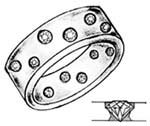
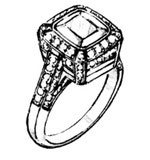
Drawing of a ring set with an emerald-cut stone

Bar Setting

Description : This is a variation of the channel setting. In a bar setting, gemstones are placed one by one between fine vertical bars of metal, resembling railway tracks.

Cut : Ideal for baguette, emerald, oval, princess, round, and square cut stones.

Jewellery : The bar setting creates a look that is both classic and modern. The open sides of the gemstone allow maximum light to pass through, enhancing brilliance and sparkle.

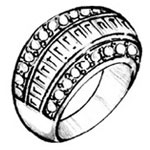
Drawing of a wide ring set with stones

Bezel Setting

Description : In a bezel setting, a variation of the prong setting, a cone-shaped hollow is cut into the metal to hold the stone. The surrounding metal is pressed around the edges of the stone. Unlike prongs, the metal in a bezel setting does not cover the top of the gemstone.

Cut : This setting offers excellent protection for stones of all sizes. Since the crown of the stone rises above the setting, it still catches the light effectively.

Jewellery : Bezel settings give jewellery a smooth, elegant, and modern appearance with a uniform finish.

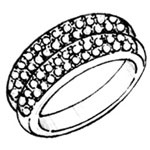
Drawing of a wide pavé-set ring

Channel Setting

Description : In a channel setting, gemstones are placed side by side along a band formed by two parallel grooves of fine metal. This setting allows the stones to display their full brilliance. However, it is essential that each stone has a precisely cut pavilion.

Cut :  The channel setting is often used for small gemstones of equal size. It is particularly popular in modern designs featuring round, baguette, emerald, oval, princess, and square cut stones. Since the stones are set flush against each other without gaps or metal between them, rectangular and square shapes create a striking visual effect.

Jewellery : This setting is especially popular in bridal jewellery, such as the classic white gold wedding band adorned with diamonds. It is also commonly seen in tennis bracelets. The name “tennis bracelet” reportedly dates back to the 1987 US Open, when tennis champion Chris Evert’s diamond bracelet came loose mid-match. The game was paused while she retrieved it — and the rest is channel setting history.

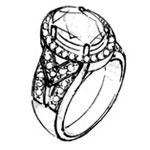
Drawing of a diamond-set ring

Prong Setting

Description : The prong setting is the most widely used method for securing gemstones. In this technique, the stone is held in place by three to six evenly spaced prongs that form a cradle. The tips of the prongs are bent over the stone to hold it securely. Prongs can be rounded, oval, pointed, squared, or flat, and may also include decorative features known as “designer prongs.”

Cut : The prong setting is highly adaptable and suitable for most gemstone shapes and sizes. Its elevated structure allows optimal light to pass through the stone, enhancing its brilliance.

Jewellery : Prong settings are common in all types of jewellery, particularly solitaire rings, engagement rings, and classic wedding pieces. The iconic six prong “Tiffany” setting, developed in 1886 by Tiffany & Co. in New York, is considered the ultimate engagement ring design. Prong settings are also often paired with pavé settings and are ideal for delicate ring shoulders or smaller gemstones.

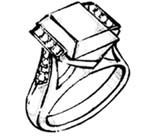
Drawing of a wide diamond-pavé ring

Pavé Setting

Description : In a pavé setting, many small gemstones are placed closely together to create the illusion of a continuous, glittering surface. The stones resemble tiny cobblestones, and only a minimal amount of metal is visible. They are held in place by small metal beads, enhancing the sparkle and fluid appearance of the surface.

Cut : Pavé settings work best with baguette, emerald, oval, princess, round, and square cut stones.

Jewellery : This setting is frequently combined with other mounting styles to enhance overall brilliance and detail.

Drawing of a ring with a centre stone

Bezel Setting

Description : In a bezel setting, the gemstone is encircled by a precisely crafted metal band that partially or fully covers its sides. The edge of this band may be straight or curved, allowing for either a full or partial bezel, such as a half bezel setting. This ancient technique enhances the contours of the gemstone, giving the piece a timeless yet contemporary look. Bezel settings require meticulous craftsmanship to ensure perfect alignment and balance from every angle.

Cut : The bezel setting is suitable for most gemstone shapes but is less ideal for stones with sharp edges or right angles. Oval and round stones are typically the easiest to set using this technique.

Jewellery : Because the bezel setting protects the gemstone’s edges, girdle, and pavilion, it is especially well suited for people with an active lifestyle. It is commonly used in earrings, bracelets, necklaces, and rings. This setting is also ideal for designs with wide shoulders or larger gemstones.